
1. Introduction to "How Does It Work?"
This illustrated book, "How Does It Work?", published by MILAN, is designed to answer common questions children aged 6-10 have about the world around them. It follows two children, a sister and a brother aged 6 and 9, through a typical day, exploring various objects and phenomena they encounter.
The book is structured into five main parts, each focusing on a different environment or activity:
- Heima: Explores the workings of household items and utilities.
- On the Way to School: Covers mechanisms encountered during travel and in public spaces.
- At School: Delves into school supplies and learning tools.
- Hádegismatur: Explains the science behind food preparation and appliances.
- Slökun: Addresses questions related to entertainment and leisure activities.
Each section features clear, precise texts accompanied by engaging illustrations, including large scenes, vignettes, and detailed diagrams, to make complex concepts accessible and understandable for young readers.
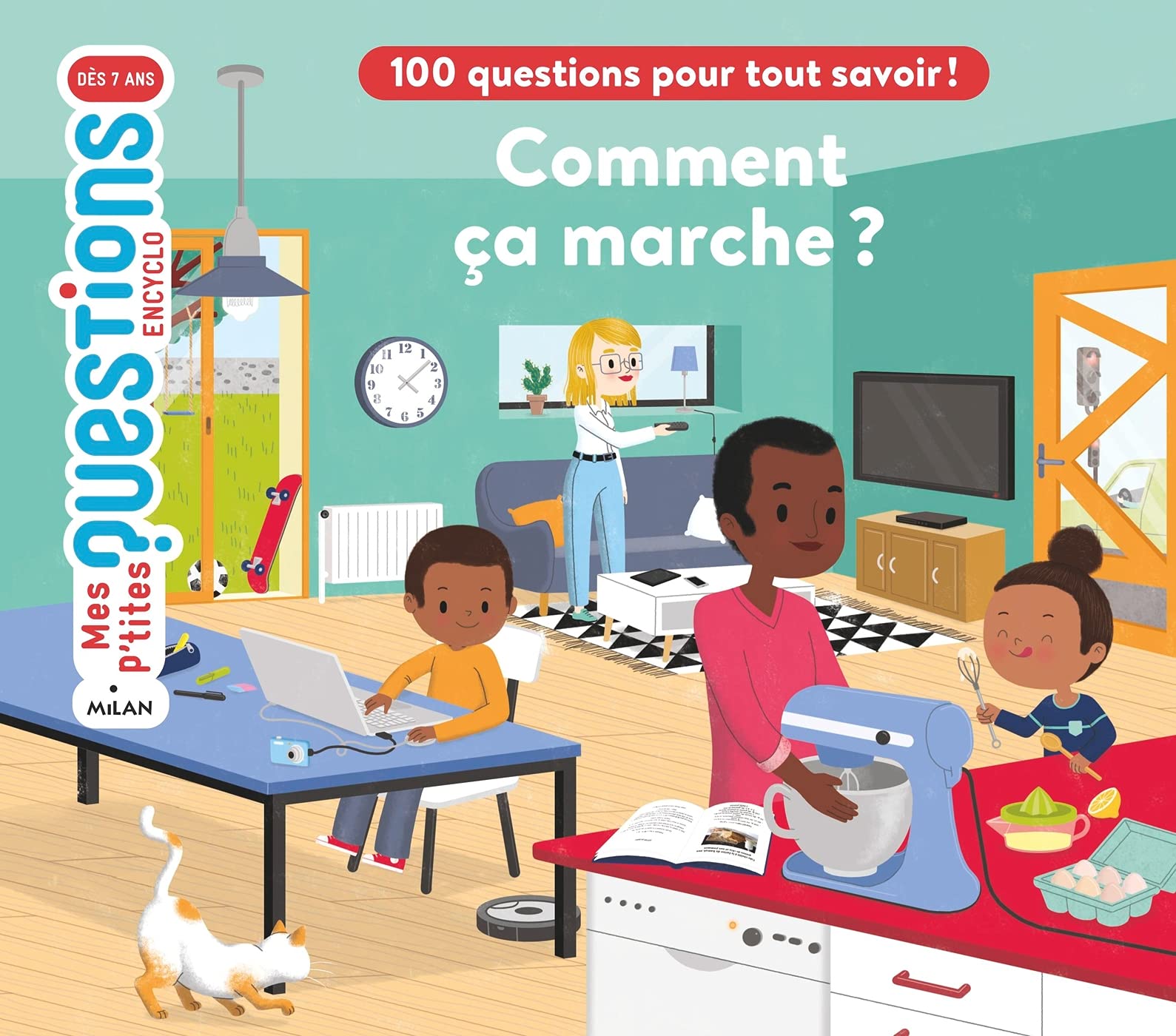
Image 1: Front cover of the "How Does It Work?" book. It depicts an illustrated scene of children in a home environment, interacting with a laptop, a kitchen mixer, and other everyday objects, with text indicating "100 questions pour tout savoir!" (100 questions to know everything!) and "Comment ça marche ?" (How does it work?).
2. Using the Book for Learning
This book is designed for interactive learning and discovery. Here are some suggestions for maximizing its educational value:
- Lesa saman: For younger children (6-7 years), reading with an adult can enhance comprehension and encourage discussion. Adults can elaborate on concepts or help connect them to real-world experiences.
- Explore Independently: Older children (8-10 years) can explore the book independently, choosing topics that pique their curiosity. The clear structure and engaging illustrations support self-directed learning.
- Focus on Questions: Each section is built around specific questions. Encourage children to formulate their own questions about daily objects and then find the answers within the book.
- Observe and Discuss: After reading about a particular mechanism, encourage children to observe the real-life object (e.g., a washing machine, a traffic light) and discuss how it works based on what they've learned.
- Utilize Illustrations: The detailed illustrations are integral to understanding. Guide children to examine the diagrams and scenes to visualize the explanations.
2.1. Dæmiample Questions Addressed:
- How does electricity reach my home?
- Why does a light bulb get hot?
- Where does tap water come from?
- How are stripes made in toothpaste?
- How does a washing machine operate?
- How does a lock recognize the correct key?
- Who controls traffic lights?
- Why does a jackhammer make so much noise?
- How does an automatic dispenser function?
- How does a computer work?
- Can objects also be printed (3D printing)?
- Why doesn't a fountain pen leak?
- How does a refrigerator produce cold?
- How does a toaster know when toast is ready?
- How does an oven cook food?
- How do images appear on television?
- How is a football manufactured?
- Who answers my questions on the Internet?
- How does the home internet box work?
3. Umhirða og viðhald
To ensure the longevity and readability of your "How Does It Work?" book, please follow these care guidelines:
- Geymsla: Store the book in a dry place, away from direct sunlight and extreme temperatures, to prevent page discoloration or binding damage.
- Meðhöndlun: Encourage gentle handling, especially with younger readers, to avoid tearing pages or damaging the spine.
- Þrif: If necessary, gently wipe the cover with a soft, dry cloth. Avoid using liquids or abrasive cleaners.
- Vörn: Consider using a bookmark instead of folding pages to mark progress.
4. Bilanaleit og stuðningur
If a child encounters difficulty understanding a concept or has further questions beyond the scope of the book, consider the following:
- Lesið kaflana aftur: Sometimes, re-reading a section or looking at the illustrations again can clarify understanding.
- Adult Explanation: An adult can provide additional context or simpler explanations tailored to the child's understanding level.
- Practical Demonstrations: Where safe and appropriate, a practical demonstration of the concept (e.g., how a light switch works) can be highly effective.
- External Resources: For deeper dives, consider exploring other age-appropriate educational resources, documentaries, or websíður.
For any inquiries regarding the publication or content, please contact the publisher, MILAN, directly.
5. Vörulýsing
| Titill | Comment ça marche ? (How Does It Work?) |
| Brand/Publisher | MÍLANÓ |
| Höfundar | Stéphane Frattini (Author), Coline Citron (Illustrations) |
| Snið | Hardcover (Relié) |
| Útgáfudagur | 22. mars 2017 |
| Tungumál | French (Original) |
| Fjöldi síðna | 80 síður |
| ISBN-10 | 2745975676 |
| ISBN-13 | 978-2745975676 |
| Lestraröld | 6 - 10 ára |
| Mál | 25.5 x 1.3 x 22.5 cm |
| Þyngd hlutar | 600 g |
6. Upplýsingar um ábyrgð og stuðning
As an educational book, this product does not typically come with an electronic device warranty. However, for any concerns regarding manufacturing defects or content accuracy, please refer to the publisher's official contact channels.
Útgefandi: MÍLANÓ
For further assistance, please visit the official MILAN publishing websíðuna eða hafðu samband við þjónustudeild þeirra.